
- “Hiflo Rotacaps 500 Mcg (Salmeterol & Fluticasone)” already exists in your wishlist
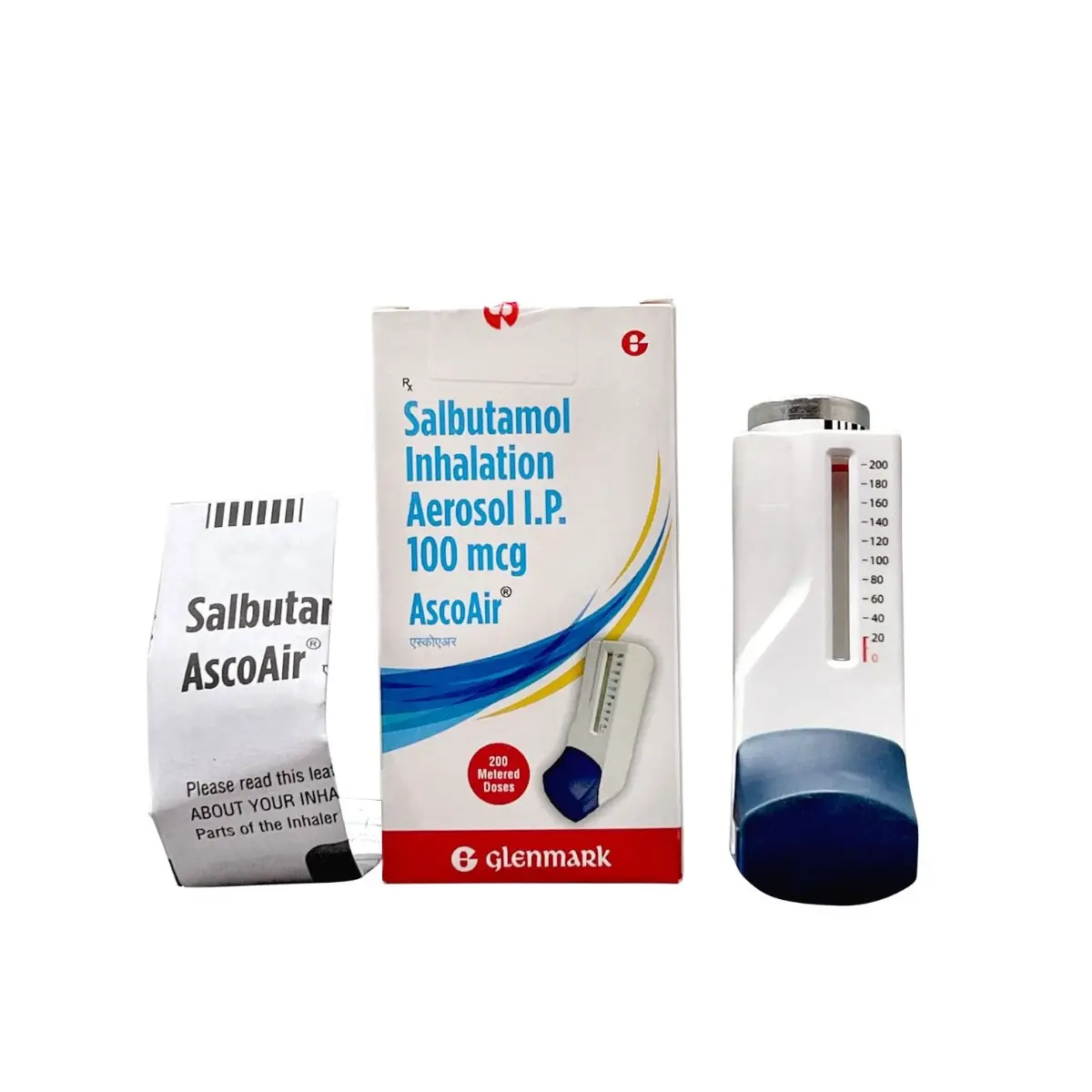
Asco Air Inhaler
Price range: $35.00 through $130.00
| Active Ingredient: | Salbutamol |
|---|---|
| Indication: | Asthma |
| Manufacturer: | Glenamrk |
| Packaging: | 200 MDI in 1 Inhaler |
| Strength: | 100mcg |
| Delivery Time: | 6 To 15 days |
Asco Air Inhaler:-
If you or someone you care for manages asthma or a chronic breathing condition, you have likely come across many different inhaler options. The Asco Air Inhaler is one device that has been gaining attention for its practical design, ease of use, and reliable medication delivery. This article covers everything you need to know — from how it works to who benefits most from using it.
What Are Asco Air Inhalers?
The Asco Air Inhaler is a breath-actuated pressurised metered dose inhaler (pMDI) designed to deliver precise doses of respiratory medication directly into the airways. Unlike conventional MDI inhalers that require you to press a canister and inhale at the same time, the Asco Air Inhaler triggers automatically when you breathe in.
This makes it particularly useful for patients who struggle with the coordination demands of standard inhalers — including older adults, children, and anyone who has found conventional devices difficult to use correctly.
The device is compatible with a range of standard inhaler canisters — including salbutamol, beclomethasone, and other commonly prescribed respiratory medications — making it a versatile option across different treatment categories for both asthma and COPD management.
How Does the Asco Air Inhaler Work?
The Asco Air Inhaler uses a spring-loaded, breath-actuated mechanism that responds automatically to your inhalation. Here is a simple breakdown of the process:
- Loading — The canister is inserted into the Asco Air device and the cover is opened to prime the spring mechanism
- Inhalation trigger — When you place the mouthpiece between your lips and begin to breathe in, your incoming airflow releases the spring automatically
- Dose release — At the precise moment inhalation begins, the mechanism fires — releasing a measured aerosol dose of medication in perfect synchronisation with your breath
- Deep lung delivery — Because actuation and inhalation are perfectly timed, more medication reaches the lower airways rather than depositing in the mouth and throat
This automatic synchronisation is the core advantage of the Asco Air Inhaler over a standard Metered Dose Inhaler (MDI). With a conventional MDI, even a small mistiming between pressing and inhaling can significantly reduce how much medication actually reaches the lungs.
Benefits of the Asco Air Inhaler
The Asco Air Inhaler offers several meaningful advantages for patients managing respiratory conditions:
- No coordination required — The device fires automatically, removing the most common cause of poor inhaler technique in one step
- Consistent dose delivery — Every inhalation triggers a precisely measured dose — no guesswork, no wasted medication
- Better lung deposition — Improved timing means more medication reaches the lower airways where it is actually needed
- Compatible with standard canisters — Works with a wide range of commonly prescribed MDI medications without requiring a new prescription
- Suitable for all ages — From older children to elderly patients, the Asco Air Inhaler works reliably across age groups with varying coordination ability
- Compact and portable — The device maintains a manageable size suitable for everyday carry in a bag or pocket
- Reduced oropharyngeal deposition — Better-timed actuation means less medication deposits in the mouth and throat, reducing the risk of local side effects like oral thrush from inhaled corticosteroids
- Easy to clean and maintain — The device components are straightforward to disassemble and clean regularly
Limitations and Risks
While the Asco Air Inhaler offers genuine advantages, it is important to understand its limitations as well:
- Requires adequate inspiratory flow — The breath-actuation mechanism needs sufficient inhalation force to trigger correctly. Patients with severely reduced inspiratory flow — such as those with advanced COPD — may not trigger the device reliably
- Not suitable for very young children — Infants and toddlers who cannot breathe in through a mouthpiece independently require a spacer with face mask rather than a BAI device
- Spring mechanism requires correct preparation — The device must be properly loaded and the cover fully opened before each use. Incomplete preparation can result in failed actuation
- Not a nebuliser replacement — For patients requiring high-dose nebulised therapy during severe acute episodes, a BAI device is not a suitable substitute
- Regular cleaning is essential — Moisture and medication residue buildup can affect the mechanism’s performance if the device is not cleaned consistently
Who Should Use the Asco Air Inhaler?
The Asco Air Inhaler is particularly well-suited for:
- Patients who struggle with standard MDI coordination — Anyone who consistently mistimes the press-and-breathe action of a conventional inhaler
- Elderly patients — Those with reduced hand strength, dexterity, or reaction time who find conventional inhalers unreliable
- Older children and teenagers — Those who have outgrown spacer-dependent inhalers but still find conventional MDI coordination challenging
- Patients with arthritis — Individuals for whom pressing a standard MDI canister is painful or physically difficult
- Anyone seeking more consistent dosing — Patients who want greater confidence that every dose is delivered correctly and effectively
It is equally suitable for patients managing asthma, COPD, exercise-induced bronchoconstriction, and other conditions requiring regular inhaled medication. If you are unsure whether the Asco Air Inhaler is the right device for your needs, speak with your doctor or pharmacist for personalised guidance.
How to Use the Asco Air Inhaler?
Follow these steps for correct, effective use every time:
- Insert the canister — Place your prescribed medication canister firmly into the Asco Air Inhaler device body
- Shake the inhaler — Shake the assembled device vigorously for several seconds to ensure the medication is evenly dispersed
- Open the mouthpiece cover — Lift the cover fully upward until it clicks — this primes the spring-loaded actuation mechanism
- Breathe out gently — Exhale slowly and completely away from the device mouthpiece — never breathe out into the inhaler
- Form a seal — Place the mouthpiece between your teeth and seal your lips firmly around it
- Breathe in steadily — Inhale steadily and deeply through your mouth — the device will fire automatically as you begin breathing in
- Hold your breath — Remove the inhaler from your mouth and hold your breath for ten seconds, then exhale slowly
- Close the cover — Close the mouthpiece cover completely after each use to reset the mechanism and protect the device
- Rinse your mouth — If your medication contains an inhaled corticosteroid, rinse your mouth with water and spit immediately after use
Complete Asthma Care Guide:- Asthma Inhalers: Types, Uses, Benefits & Complete Treatment Guide.
Common Mistakes to Avoid
Even with a breath-actuated device, certain errors can reduce treatment effectiveness:
- Not opening the cover fully — A partially opened cover prevents the spring mechanism from priming correctly — always open it until it clicks
- Exhaling into the mouthpiece — Breathing out through the device introduces moisture that damages the powder and mechanism
- Inhaling too slowly — A very slow, weak inhalation may not generate sufficient airflow to trigger the actuation mechanism reliably
- Covering the air vents — Blocking the device’s side air vents with your fingers disrupts the airflow trigger — hold the device carefully
- Skipping the breath hold — Not holding your breath for ten seconds after actuation significantly reduces how much medication settles in the lower airways
- Forgetting to shake — Always shake the canister before use to ensure an accurate, evenly dispersed dose
- Skipping mouth rinsing — For corticosteroid medications, skipping the mouth rinse increases oral thrush risk significantly
Asco Air Inhaler – Comparison Table
| Feature | Asco Air Inhaler | Standard MDI | Dry Powder Inhaler (DPI) | Soft Mist Inhaler |
|---|---|---|---|---|
| Coordination required | ❌ None | ✅ Yes | ❌ None | ❌ Minimal |
| Propellant used | ✅ Yes (HFC) | ✅ Yes (HFC) | ❌ No | ❌ No |
| Suitable for the elderly | ✅ Excellent | ⚠️ Moderate | ⚠️ Moderate | ✅ Excellent |
| Requires high inspiratory flow | ⚠️ Moderate | ❌ No | ✅ Yes | ❌ No |
| Spacer compatible | ❌ No | ✅ Yes | ❌ No | ❌ No |
| Dose counter included | ⚠️ Device dependent | ⚠️ Device dependent | ✅ Most devices | ✅ Yes |
| Suitable for children | ✅ Older children | ✅ With spacer | ✅ Age 5+ | ✅ Yes |
| Environmental impact | ⚠️ Moderate | ⚠️ Moderate | ✅ Lower | ✅ Lower |
| Canister compatibility | ✅ Standard MDI canisters | ✅ Standard | ❌ Device-specific | ❌ Device-specific |
For more information on different inhaler types and how they compare, explore our dedicated respiratory device guides, including Metered Dose Inhalers (MDI), Dry Powder Inhalers (DPI), and Soft Mist Inhalers.
Frequently Asked Questions?
What is the Asco Air Inhaler used for?
The Asco Air Inhaler is a breath-actuated device used to deliver prescribed inhaled medications for asthma, COPD, and other respiratory conditions — automatically triggering on inhalation without requiring manual coordination.
Is the Asco Air Inhaler the same as a standard MDI?
No. While it uses the same MDI canisters, the Asco Air Inhaler fires automatically when you breathe in — unlike a standard MDI which requires you to press and inhale simultaneously.
Can children use the Asco Air Inhaler?
Yes — for older children and teenagers who can breathe in through a mouthpiece independently. Very young children and infants require a spacer with face mask rather than a BAI device.
Do I still need a separate reliever inhaler with the Asco Air Inhaler?
No — if your reliever canister is compatible with the Asco Air device, you can use it as your rescue inhaler. Always confirm canister compatibility with your pharmacist.
How often should I clean the Asco Air Inhaler?
Clean the mouthpiece and device body at least once weekly using a clean, damp cloth. Never immerse the device in water or use the device while wet.
Can the Asco Air Inhaler be used for COPD?
Yes — provided the patient can generate adequate inspiratory flow to trigger the breath-actuation mechanism. Patients with severely advanced COPD should confirm suitability with their respiratory specialist.
What should I do if the device does not fire when I inhale?
Check that the mouthpiece cover is fully opened and the canister is correctly inserted. If the problem persists, contact your pharmacist — do not attempt to press the canister manually while using the device as a BAI.
Medical Disclaimer:-
The information in this article is for general informational purposes only and does not constitute medical advice. The Asco Air Inhaler and all inhaled medications must be used under the guidance of a qualified healthcare professional. Always follow your prescribed treatment plan and consult your doctor or pharmacist if you have questions about your inhaler device or medication.
Related Brands:-
Albuterol Inhaler (Generic) (Bonair)
Ventorlin Inhaler 100 Mcg (Salbutamol)
Additional information
| unit | 20 Inhaler, 5 Inhaler, 10 Inhaler |
|---|



Reviews
There are no reviews yet.